

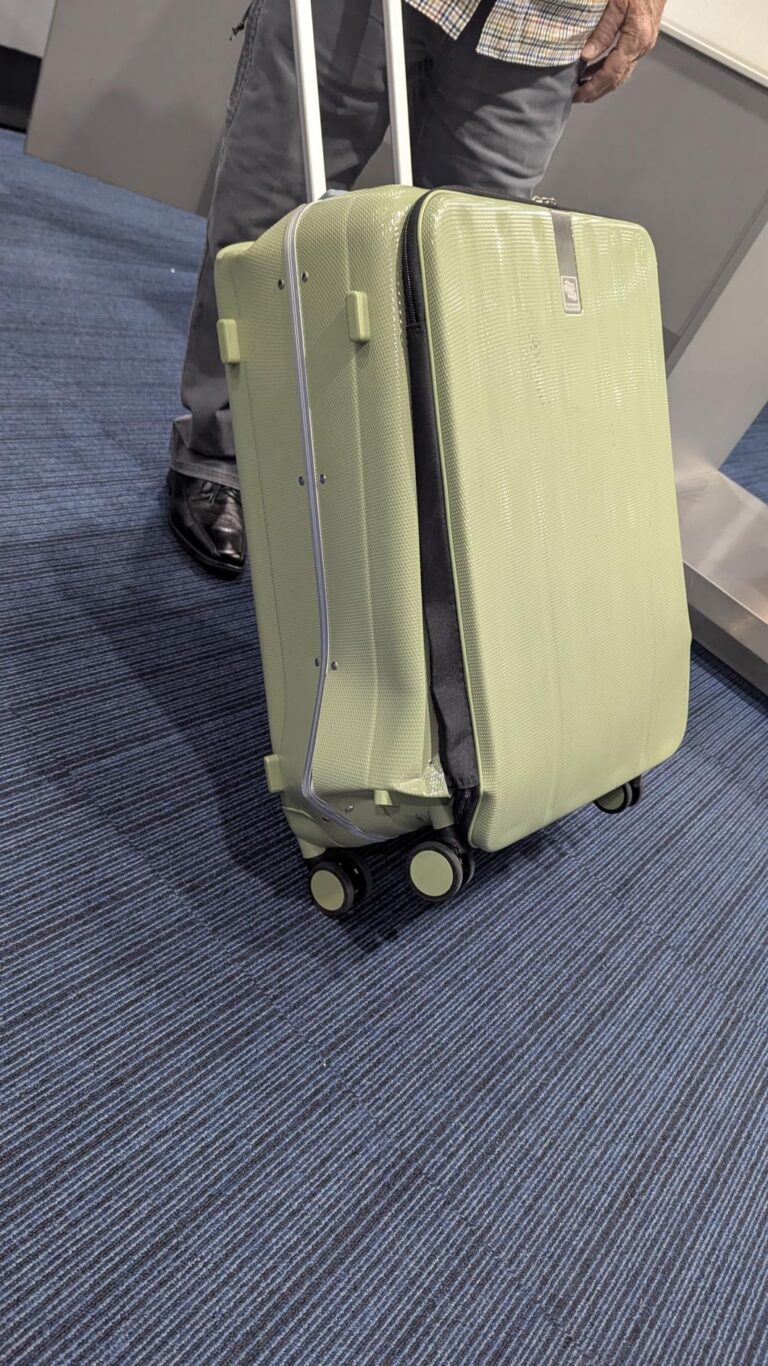
The Hanke 20-Inch Carry-On Luggage is an interesting alternative to a conventional clamshell suitcase. Instead of splitting into two equal halves across a bed or hotel-room floor, the Hanke H9860 uses a top-opening trunk-style design that lets you access most of the packing space from one side.
That design is the main reason to consider it. It should work particularly well for travelers who frequently stay in smaller hotel rooms, travel by train, or simply dislike opening a suitcase completely flat every time they need something.
There are trade-offs, though. At 7.9 pounds, this is not an especially lightweight carry-on, and its published overall dimensions of 22 × 14.7 × 9.5 inches are slightly larger than some common cabin-bag limits. This is therefore a suitcase I would consider for its organization and space-saving design rather than for travelers whose first priority is minimizing weight or fitting the strictest airline baggage sizers.
Our verdict: the Hanke is worth considering if you specifically want a top-opening hard-shell carry-on and appreciate having one main packing compartment. Just check the dimensions against your airline before relying on it as a cabin bag.
Hanke 20-Inch Carry-On review summary
Overall rating: 4.1/5 — research-based editorial rating
Best for: Travelers who want a hard-shell suitcase that opens without requiring as much floor or bed space as a traditional clamshell.
Avoid if: You frequently fly airlines with strict carry-on size or weight limits, or you want an ultralight suitcase.
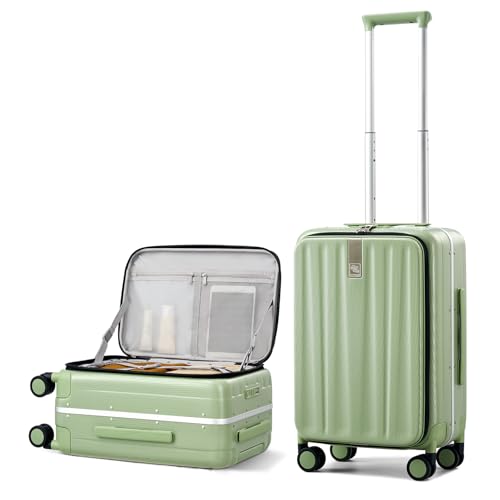
Exact model reviewed: Hanke H9860 / HKUSKH9860, 20-inch Bamboo Green, ASIN B0CGRN3CR6.
Main advantage: The top-opening layout makes packing and accessing the suitcase more convenient in tight spaces.
Main disadvantage: The published 22 × 14.7 × 9.5-inch overall dimensions may exceed some airlines’ cabin-bag limits.
Product source: Research-based review.
What is the Hanke H9860 carry-on?
The Hanke H9860 is a 20-inch polycarbonate hard-shell suitcase built around a less conventional top-opening layout.
Traditional hard-shell suitcases normally unzip around the middle. You place the suitcase flat, open both halves and pack into two relatively shallow compartments. Hanke instead puts most of the packing space into a deeper main compartment with an opening panel on one side.
That sounds like a small change, but it affects how you use the suitcase.
If you are staying in a compact hotel room, you do not necessarily need enough space to spread the entire suitcase open. You can access the packing compartment more like a trunk.
Hanke lists the case at approximately 35.3 liters of capacity and 7.9 pounds empty. Published packing dimensions are approximately 13.5 × 19.2 × 8.3 inches, while the overall exterior measurements including handles, wheels and protective feet are listed as 14.7 × 9.5 × 22 inches.
Top-opening design is the Hanke’s biggest advantage
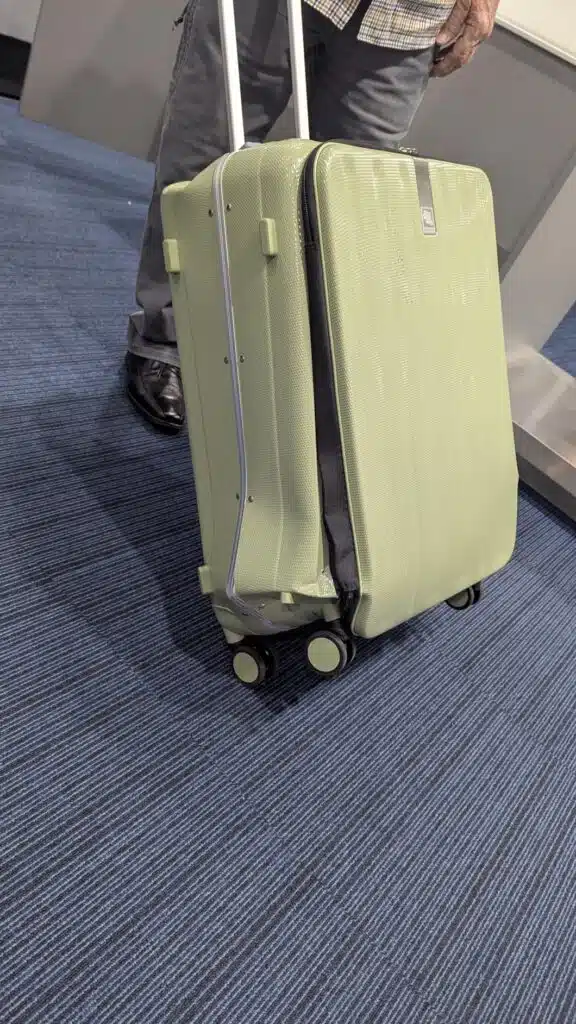
The strongest argument for buying this suitcase is not the color, lock or hard shell. It is the opening mechanism.
A standard clamshell carry-on effectively doubles its footprint when opened. That is rarely a problem at home, but it can become annoying in small hotel rooms, cruise cabins or bedrooms where your only available packing surface is the bed.
The Hanke’s trunk-style configuration keeps most of your belongings inside one deeper compartment.
That can also make it easier to pack bulkier items. Instead of dividing everything between two similarly sized halves, you have a larger primary storage area to work with.
Hanke describes the design as helping reduce item displacement when opening and closing the case. The basic principle makes sense: your belongings remain inside the deeper body of the suitcase rather than being split between two hinged shells.
There is a trade-off.
People who deliberately divide their packing into two clamshell sections — clothes on one side and shoes or equipment on the other, for example — may actually prefer a conventional layout.
The Hanke design is different rather than universally better.
Design and build quality
The H9860 uses a polycarbonate hard shell with a textured exterior. Hanke says the diamond-patterned finish is intended to resist visible scratching and describes the shell as more durable than common ABS/polycarbonate blends. Those durability statements are manufacturer claims rather than results from LuggageRate testing.
Polycarbonate is nevertheless a sensible material for this type of suitcase. It can flex under pressure while maintaining a rigid enough structure to protect packed belongings.
The Amazon listing also describes an aluminum frame as part of the suitcase’s construction.
One detail worth understanding is that this should not be confused with a fully latch-closed, zipperless aluminum-frame suitcase. The current listing also specifically describes a zipper as part of the H9860’s construction.
For security, Hanke supplies a built-in combination lock using a TSA-compatible lock cylinder. That can prevent the main opening from being casually opened while still allowing authorized baggage inspection.
As with any luggage lock, however, it should be viewed mainly as a deterrent rather than high-security protection for valuable belongings.
Capacity and organization
With approximately 35.3 liters of published capacity, the Hanke sits around the useful range for short trips and minimalist longer trips.
How much travel you can get from 35 liters depends heavily on how you pack. For a light packer, it can be enough for several days. Bulky winter clothing, multiple pairs of shoes or camera equipment will consume the available volume much more quickly.
The deeper top-opening compartment should be particularly useful for packing cubes.
Rather than arranging cubes across two shallow halves, you can stack them within the main compartment and access them from the opening panel. That may also make living out of the suitcase easier because you can remove one cube without completely unpacking everything else.
The trade-off is that items buried at the bottom of a deep compartment may require moving whatever is packed above them.
For travelers who want instant access to lots of small pockets, a soft-sided carry-on or luggage with a dedicated front organizer could still be more practical.
Wheels, handle and maneuverability
Hanke equips the H9860 with eight multi-directional spinner wheels, effectively four double-wheel assemblies. The company also lists a four-position telescopic handle with an ergonomic grip.
That combination should make the suitcase capable of rolling upright in multiple directions, which is useful through airports and hotel corridors.
Because this is a research-based review, however, we cannot confirm how quiet the wheels are, whether they develop play after repeated trips, or how well they perform over broken pavement, carpeting and other uneven surfaces.
Those details matter.
A spinner suitcase can feel extremely smooth on an airport terminal floor yet perform very differently on sidewalks or cobblestones. We would therefore treat Hanke’s claims about maneuverability as specifications rather than evidence of long-term wheel performance.
The four-height telescopic handle is a useful feature on paper because travelers of different heights can choose a more comfortable position.
Weight, dimensions and airline suitability
This is the area where buyers should pay the most attention.
Hanke publishes the following specifications for this 20-inch model:
- Overall dimensions: approximately 22 × 14.7 × 9.5 inches, including handles, wheels and protective feet
- Packing dimensions: approximately 19.2 × 13.5 × 8.3 inches
- Capacity: approximately 35.3 liters
- Empty weight: approximately 7.9 pounds
These are manufacturer-published figures rather than measurements independently verified by LuggageRate.
The 22-inch height is carry-on friendly for many situations, but the 14.7-inch width and 9.5-inch depth deserve attention.
Airlines do not use one universal carry-on standard. Limits can change according to carrier, route, fare, aircraft and sometimes ticket class. International and budget airlines can also impose relatively strict cabin-bag weight limits.
For that reason, I would not buy the Hanke H9860 simply because a retailer describes it as “airline approved.”
Check your airline’s current published allowance and compare it with the full exterior dimensions, including wheels and handles.
Weight-conscious travelers should pay attention too.
Starting at 7.9 pounds leaves less packing allowance than a carry-on weighing five or six pounds when flying an airline that enforces a cabin baggage weight limit.
What should you expect in real travel?
The H9860’s design makes the most sense when your travel involves frequently opening your suitcase.
Imagine arriving at a compact hotel and placing the case against a wall or beside a luggage rack. With a traditional clamshell, accessing your clothes may require moving the suitcase onto the bed and opening both halves.
The Hanke should require less space because its deeper body stays relatively stationary while the opening panel moves out of the way.
That can be especially useful on multi-city trips where you never completely unpack.
There are also situations where the advantage matters less.
If you normally unpack everything into drawers as soon as you arrive, a top-opening case will not dramatically change your trip. Likewise, if maximum lightweight capacity matters more than hotel-room convenience, the relatively substantial 7.9-pound empty weight becomes a more important consideration.
Because we have not personally flown with this H9860, we cannot verify overhead-bin fit, wheel durability, scratch resistance or long-term handle performance.
Hanke 20-Inch Carry-On pros and cons
Pros
- The top-opening design requires less open floor space than a traditional two-sided clamshell suitcase.
- A deep primary compartment can work particularly well with packing cubes and bulkier belongings.
- The polycarbonate hard shell should provide more structure around packed items than a soft-sided bag.
- Eight spinner wheels allow multidirectional rolling.
- A four-position telescopic handle offers more adjustment than a basic fixed-height system.
- The integrated combination lock avoids needing a separate luggage lock.
- Approximately 35.3 liters provides useful capacity for short trips without moving into checked-luggage territory.
Cons
- At 7.9 pounds empty, it is considerably heavier than many lightweight carry-ons.
- The published 14.7-inch width and 9.5-inch depth may exceed the cabin-bag limits of some airlines.
- The deep single-compartment layout will not suit travelers who prefer separating belongings between two clamshell halves.
- Manufacturer scratch-resistance and durability claims have not been independently tested by LuggageRate.
- No clear manufacturer warranty term was visible in the product information we reviewed, so buyers should verify warranty coverage before ordering.
Who is the Hanke 20-Inch Carry-On best for?
The Hanke is most compelling for travelers who regularly stay in small hotel rooms or other spaces where opening a conventional hard-shell suitcase is inconvenient.
It also suits people who prefer packing cubes and like having one deep primary compartment.
Business travelers moving between hotels, rail travelers, urban travelers and anyone living directly out of their suitcase may get more benefit from the top-opening design than someone taking a straightforward resort vacation.
The distinctive trunk-style shape may also appeal if you want something different from the huge number of near-identical clamshell spinner suitcases on the market.
Who should avoid it?
Look elsewhere if your priority is the lightest possible carry-on.
A 7.9-pound suitcase uses a meaningful portion of your baggage allowance before you have packed anything, particularly on airlines with strict weight restrictions.
Frequent flyers whose regular carrier uses a particularly narrow or shallow baggage sizer should also compare the Hanke’s dimensions carefully.
And if you love the traditional clamshell setup because it naturally separates two people’s belongings or keeps shoes away from clothing, the Hanke’s deep-compartment approach may actually feel less organized.
Hanke compared with traditional carry-on luggage
The key difference is not simply hard shell versus soft shell. It is top opening versus clamshell opening.
A clamshell gives you excellent visibility over almost everything once the suitcase is completely open. It is easy to divide your belongings between two halves, but you need enough horizontal space to open it.
The Hanke concentrates more packing volume into one side.
That sacrifices some at-a-glance visibility in exchange for a smaller footprint when accessing the bag.
Neither approach wins for everyone.
For travelers who regularly complain about laying their suitcase across a hotel-room floor, the Hanke solves a genuine usability problem. For travelers who usually unpack once and rarely touch their case until departure day, the benefit is much smaller.
Price, warranty and value
The H9860 makes the strongest value argument when you specifically want its top-opening architecture.
If you simply want a polycarbonate spinner carry-on, there are many alternatives, including lighter models. Paying extra for the Hanke makes more sense when the trunk-style access solves a real problem for the way you travel.
We have deliberately not included a fixed retail price because online pricing and promotions change.
Amazon’s current listing provides return-policy information but does not clearly state a Hanke manufacturer warranty duration for this exact model in the material we reviewed. Buyers who consider warranty coverage important should confirm the applicable Hanke warranty before purchasing.
Looking for more luggage options?
Visit the full review library:
Final verdict: Is the Hanke 20-Inch Carry-On worth buying?
The Hanke 20-Inch Carry-On Luggage H9860 is worth considering because it genuinely does something different from most hard-shell carry-ons.
Its biggest advantage is simple: you can access a deep packing compartment without spreading two suitcase halves across the room.
For frequent travelers staying in compact rooms, that can be more valuable than another exterior pocket or decorative feature.
The compromises are equally clear. At 7.9 pounds, this is not an ultralight carry-on, and its published 22 × 14.7 × 9.5-inch exterior dimensions mean airline compatibility needs to be checked rather than assumed.
If you value compact opening, a hard polycarbonate shell and a deeper trunk-style packing compartment, the Hanke deserves a place on your shortlist.
If low weight and maximum compatibility with strict cabin-bag limits matter more, I would choose a smaller and lighter carry-on instead.
Overall rating: 4.1 / 5
FAQ
Is the Hanke 20-Inch Carry-On luggage good?
It looks like a useful option for travelers who specifically want a top-opening hard-shell suitcase. Its biggest advantage is the ability to access a deep main compartment without fully opening a traditional clamshell case. This review is research-based, so LuggageRate has not independently verified its long-term durability.
What are the dimensions of the Hanke H9860?
Hanke publishes overall dimensions of approximately 22 × 14.7 × 9.5 inches, including wheels, handles and protective feet. Published packing dimensions are approximately 19.2 × 13.5 × 8.3 inches.
How much does the Hanke 20-Inch Carry-On weigh?
The manufacturer lists the H9860 at approximately 7.9 pounds empty.
Is the Hanke H9860 airline approved?
Do not assume universal compatibility. Airline cabin-bag requirements vary, and the Hanke’s published dimensions are 22 × 14.7 × 9.5 inches overall. Check the current allowance of the airline and fare you are flying before travel.
How much can the Hanke 20-Inch Carry-On hold?
The manufacturer lists capacity at approximately 35.3 liters, making it most appropriate for shorter trips or travelers who pack relatively light.
Does the Hanke H9860 have a TSA lock?
The listing describes an integrated combination lock using a TSA-compatible lock cylinder.
Review disclosure
This is a research-based review. LuggageRate has not personally travel-tested the Hanke H9860 for this article. Our assessment is based on the manufacturer’s published specifications, current retailer information and product research. Where performance has not been independently verified, we identify claims as manufacturer information rather than first-hand observations.